Real Estate QuickBooks CleanupOne wire, four lines.
The bank posts one deposit. The settlement statement already had the fee, the agent share, the earnest money, and the cash that was never yours.
See the four lines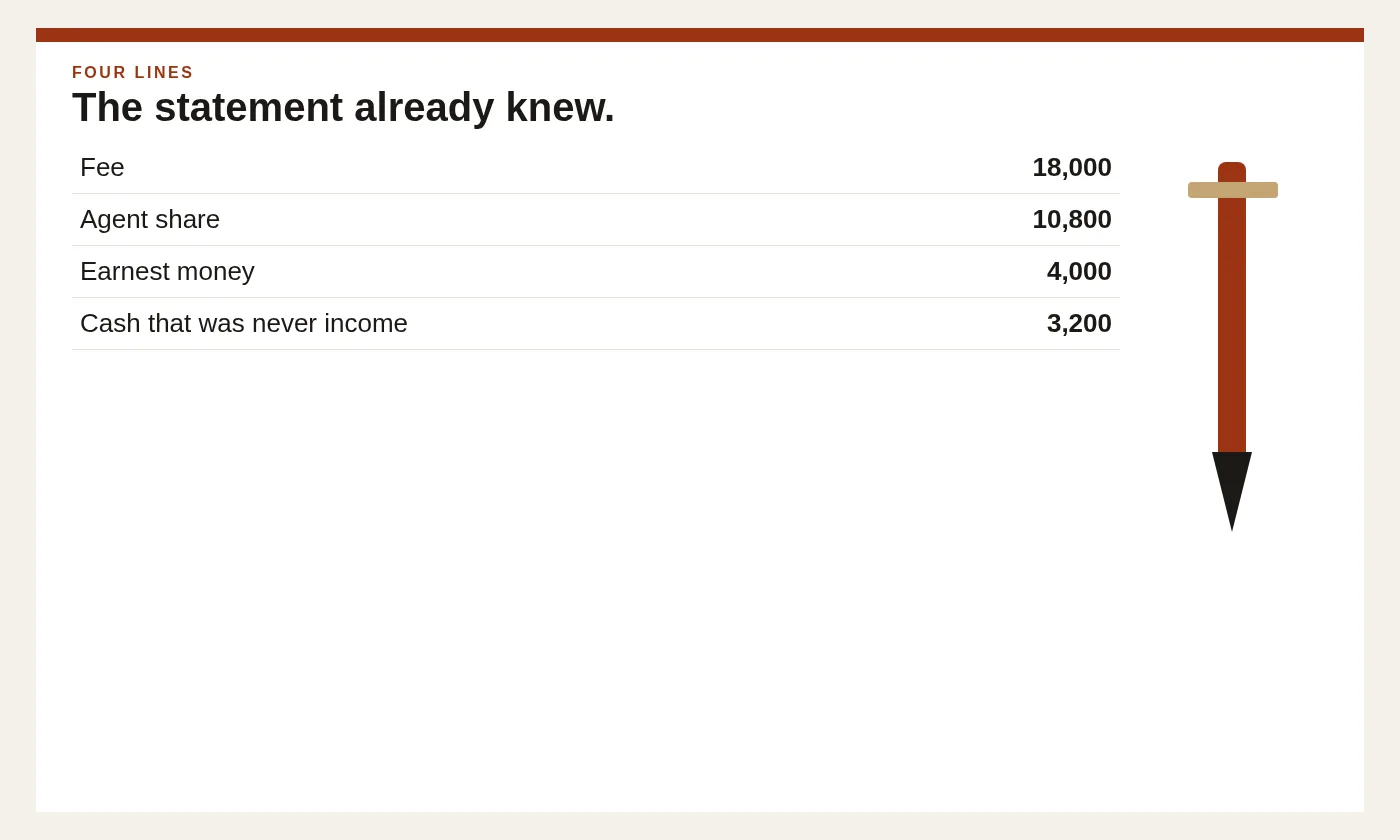
The bank posts one deposit. The settlement statement already had the fee, the agent share, the earnest money, and the cash that was never yours.
See the four linesStart with the settlement statement, not with the bank feed. The statement listed a gross commission, a split to the agent, sometimes a referral to another office, and a figure for earnest money that was only passing through. The feed kept the remainder. If that remainder is the only number in income, the year looks quieter than the work, and the cash that left has no name when the forms arrive.
We put the gross fee back as income once it is earned. The agent share is something you owe, and then something you pay. A co-broke is its own line, not a discount you remember later. If two of those were netted before anyone typed the deposit, the first look is to restore them. You still say who was paid. We do not invent the person.
Cash that was never income has to leave the profit even when it sat in the operating bank for a day. A credit from the title company for a repair the seller agreed to fund is not a fee. A refund of an overage is not a second commission. The four lines are a way to talk about the wire. They are also the chart a lender can read without a tour of the software.
The checks you send agents are not a side project. They are the agent share, kept by person, for the whole year. A payment that left with a blank name becomes a stack of copies in January. We flag those payments on the first look. You confirm the name. The file should not be the thing that forgot.
Personal cash, the brokerage, and a company that holds a rental can all touch the same week. We do not merge them to make the screen calmer. A draw by the owner is not a commission. A commission is not a draw. When those cross, a lender stops trusting the month, and so should you.
Individual estimates still land on 15 April, 15 June, 15 September, and 15 January. Corporate estimated payments land on day 15 in the 4th, 6th, 9th, and 12th months of the year. People reach for Form 1040-ES when the owner is an individual and Form 1120-W when the owner is a corporation. Form 2210 and Form 2220 are how an underpayment gets explained, and we leave any penalty line to the form. A deposit that was never split will feed those worksheets a profit that the statement does not support.
Send one closing you would not explain from memory, the split sheet, and the trust statement if earnest money sat with the brokerage. Say whether the commission posted as the net. Say whether any agent check is missing a name. That is enough to start. A price comes after someone has seen how many months fight the bank.
Leave property addresses and party names off the note on this site. The chart of amounts is the work. After the file is trustworthy, trust activity gets a look every month the account moved, and the operating bank gets a reconciliation you can hand over without rebuilding the story. You can keep that rhythm, or we can keep it with you.
The Tax CFO step is the one after the split. Once the next closing can split itself, the question becomes which doors you keep, which loan you refinance, and what the margin on brokerage income should look like before the return is copied from the year. The split is the floor. The decision is the year.
Tell us the one closing where the bank amount and the statement refuse to match.

You will be talking to the Steven Palmieri practice.